Case Study
Harvard Law School Program on Negotiation
Building a dynamic hub for the Harvard Law's Negotiation Offerings
How can we build a website that effectively communicates the work in the Programs on Negotiation while maintaining credibility and confidentiality?
Company
Harvard Law School
Skills
Information Architecture
Interactive Prototype
Duration
Oct 2024 - Feb 2024
Team
Lead Product Designer (Me)
Director of Programs on Negotiation
Overview
The Harvard Law School Negotiation Program (HNP) is launching a new website to connect with diverse audiences, including students, faculty, professionals, and high-profile stakeholders. The site will highlight key initiatives, such as the “Possibilities Lab,” and provide a central hub for information on ongoing negotiations. It must be live before Thanksgiving and continuously updated throughout the academic year.
Problem
HNP currently lacks a centralized and accessible online presence, making it difficult for stakeholders to stay informed about its work. Sensitive information, especially regarding international conflicts, needs to be presented in a way that maintains confidentiality while building credibility. The website needs to communicate the complexity and scope of HNP’s initiatives clearly and professionally while also being a hub for professors and students interested in learning more about the academic offerings of the program.
Solution
Create a website with clear navigation for students, faculty, professionals, and stakeholders, highlighting key projects, course offerings, and open roles within the department. The site will includes a number of resources to other tangentially related research and offerings within negotiation but still maintains a simple, modern design for ease of use.
Final Designs
The final designs themselves shifted as priorities for this role shifted from showcasing information related to research being done within the program for global external stakeholders to a front facing public profile for the use of students and professors in an easy and enjoyable experience.


Users
Our users include:


Current Professors
Current Law School Students
External Stakeholders
Researchers
The Challenge
How might we design and launch a centralized, accessible, and secure website for the Harvard Law School Negotiation Program (HNP) that effectively communicates the scope and complexity of its initiatives—such as the Possibilities Lab—while serving the distinct needs of students, faculty, professionals, and high-profile stakeholders, and ensuring sensitive information is presented with discretion and credibility?
With this in mind, I was given legacy work which was almost fully scratched when reconsidering the needs of our users and internal stakeholders.


Designs for Faculty and Faculty Bio Pages
Changes to Legacy
This project had a tight turnaround which only allowed for one round of feedback to be implemented. With this in mind, I conducted an internal audit of what functionalities currently existed within the legacy platform given along with specifics when it came to design inconsistencies, copy issues, and potential places for improvements. I also mapped out all existing and need web pages checked for user flow by internal stakeholders.


Map view design
Information Architecture
This project had a tight turnaround which only allowed for one round of feedback to be implemented. With this in mind, I conducted an internal audit of what functionalities currently existed within the legacy platform given along with specifics when it came to design inconsistencies, copy issues, and potential places for improvements. I also mapped out all existing and need web pages checked for user flow by internal stakeholders.

Information Architecture of Existing and New Pages.
All lighter colors are new pages I created whereas darker versions of colors exist but would need further editing.
Job Board List View
There is currently no comprehensive database for teachers to find and learn about teaching opportunities. During user interviews, we found that teachers often constantly check job listings of a few schools or districts of note, and very often do not look outside of their area because of concerns about their teacher license transferring to another state.


List view design
Iterative Feedback
After the above designs were finished in marking with our scope at the time, we presented this iteration of our work to various stakeholders to collect and incorporate feedback.
Some key findings:
-
Users would benefit from a location filter on the map view, similar to list view, if they do not wish to manually manipulate the map
-
Our license transferability measurement was too granular and difficult to interpret, instead showcasing an "easy, medium, or hard" measurement allows users to more quickly understand
-
Though adding an additional space for "average teacher salary" in our job modal is controversial for our product, this is valued highly by users in creating trust and transparency
With these findings in mind, we iterated and changed the scope of our project for the next iteration. This included a location filter, simplified license transferability scale, and the addition of average teacher salary in the job modal.


Iterated design changes on important screens
Public Design & Soft Launch

Mobile Splash Page Animation

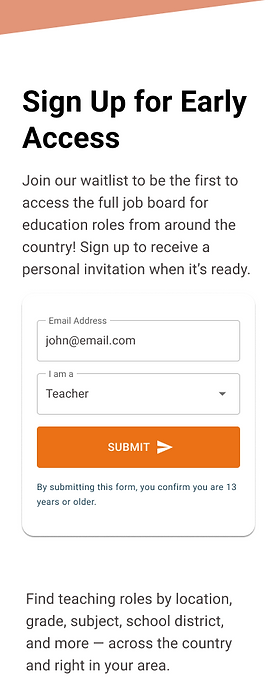


Production splash page images
Takeaways
This project is actively being tested and piloted in the field at career fairs and school fairs in New Mexico with additional features being designed. We have already seen quick engagement and excitement for WorkinEd, including recommendations on adding the "preview jobs by state" feature on our splash page as an official offering in our product.
The iterative design process, combined with user interviews, enabled us to create a homepage that effectively conveys our product's unique value proposition and engages our target audience.